
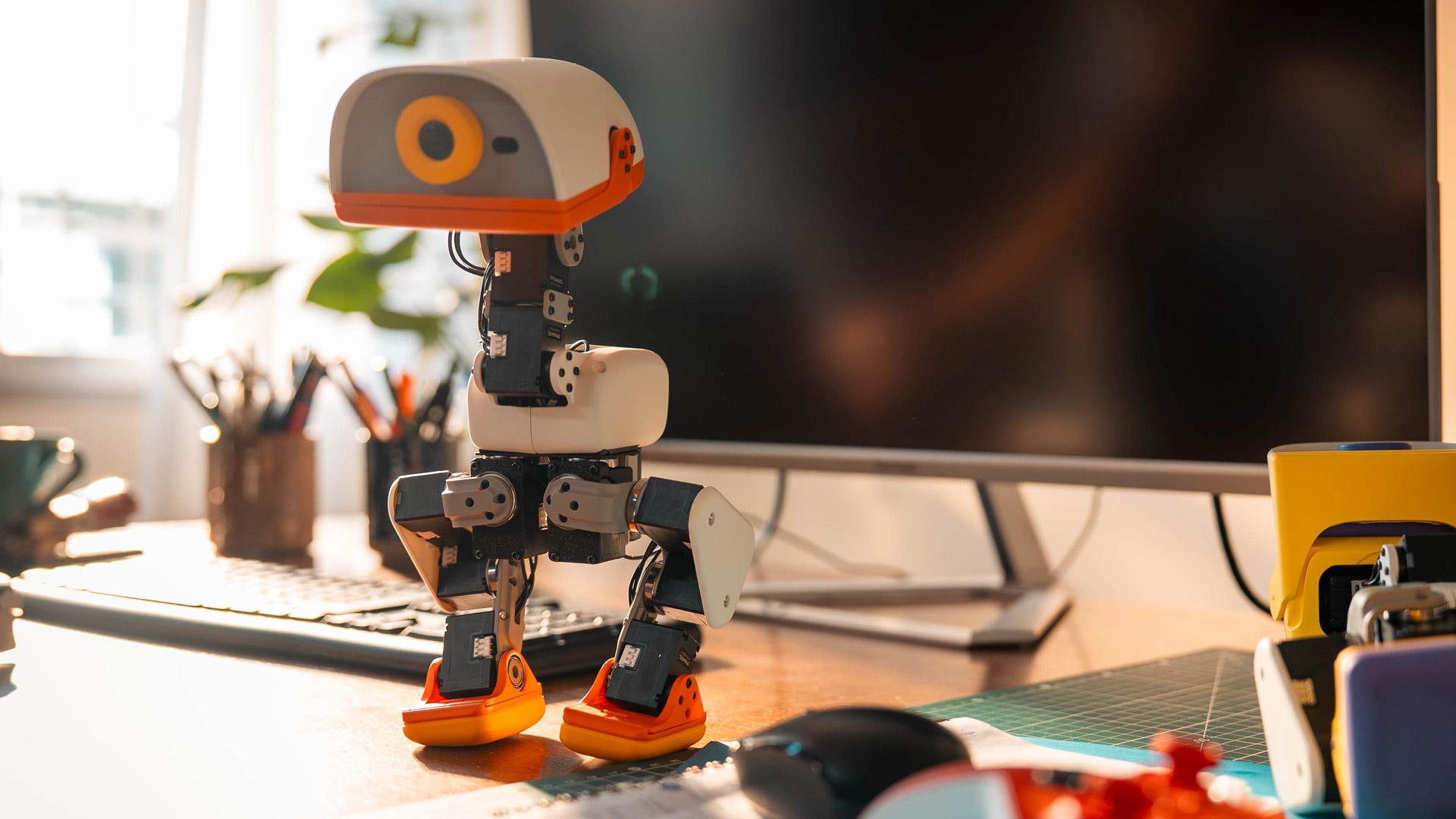
Sometimes, it takes something remarkably small to raise a much bigger question about the future. A tiny robot, just 25 centimetres tall, made me think not about artificial intelligence, programming or technological progress, but about Sebastian, who is autistic and loves animals. What if a little robot like this could actually become his companion? It may sound like a simple thought, but behind it lies something far more profound: What happens when we stop developing robots solely to perform tasks and begin exploring how technology might create joy, security, curiosity and perhaps even a sense of friendship?
It Started With a Little Duck
Sometimes, it doesn't take much to set your thoughts in motion. A short video, an unexpected invention or a technological innovation that suddenly awakens something beyond professional curiosity. That is exactly what happened when I discovered Microduck, a small two-legged robot developed by the French company Pollen Robotics.
I have watched countless robot demonstrations over the years. Machines that run, jump, lift heavy objects, perform sophisticated industrial tasks and imitate human movements with increasing precision. I am impressed by the engineering, but I am not always particularly moved by it.
Microduck was different.
There stood a little mechanical duck, just 25 centimetres tall, with an oversized head, a movable beak and two legs. It could walk, sit down, stand up, respond to controls and perform various learned movements. It looked neither particularly powerful nor especially intelligent. Yet there was something about its movements, proportions and almost comical appearance that made it instantly appealing.
I was completely captivated.
But it was only when I thought about Sebastian that my fascination took on another dimension.
Sebastian is autistic and loves animals. I know him well enough to imagine that a little creature like this might capture his curiosity. Perhaps he would love it immediately. Perhaps he would want to study how it moves, understand what it does or simply sit and watch it.
And perhaps, which was the thought that really stayed with me, he might experience it as a little friend.
Of course, I cannot know how Sebastian would actually react until he has the opportunity to encounter such a robot. But the possibility itself made me reflect on something that increasingly troubles me about technological development.
Why do we still judge robotics almost exclusively by what machines can accomplish, produce or make more efficient?
What happens if we ask a completely different question?
Not what a robot can do for us, but what it might mean to someone.
When Technology Doesn't Need to Look Human
Pollen Robotics introduced Microduck on August 27, 2026. The robot weighs approximately 800 grams and features 15 motors, a camera, distance sensors, microphones and speakers. It can be programmed and trained to perform new movements through simulation, while its software platform is open to developers.
In other words, it is considerably more than a remote-controlled toy, even if playfulness is clearly an important part of its design.
The pre-order price is $399 before taxes and shipping, with initial deliveries planned before Christmas 2026. That is not an insignificant amount of money, but neither is it a price that places personal robotics exclusively within the reach of universities and research laboratories.
What interests me most, however, is that Microduck makes no attempt to look human.
For decades, the robotics industry has maintained an almost obsessive relationship with the human body. Two arms, two legs, five fingers on each hand and a head resembling a human face. The reasoning is understandable. Our world was built around the human body, and robots designed to use our tools must be able to operate within those environments.
But when the ambition is social interaction rather than physical labour, resembling a human being may not necessarily be an advantage.
Quite the opposite.
Almost-human machines can create an unsettling psychological response. We expect human behaviour but encounter mechanical imitations that fail to match our expectations. Researchers often refer to this phenomenon as the uncanny valley.
A little robot duck largely avoids that problem.
Nobody expects it to behave like a human being. It is allowed to be strange, clumsy, curious and entirely non-human. It can tilt its head like a bird, lose its balance and struggle back to its feet.
Our brains immediately begin interpreting those movements as expressions of personality.
We already do this with living animals, animated characters and sometimes even our cars or computers. Human beings possess a remarkable ability to form emotional associations with things that appear to respond to their presence.
That does not mean Microduck experiences emotions, intentions or consciousness. Its behaviour results from software, sensors, motors and control systems.
But our experience of connection does not always require the other party to possess an inner life similar to our own.
We can feel affection for a mechanical character without believing it is a living animal. We can become attached to an object without imagining that the object loves us in return.
I believe this is where an entirely new and fascinating form of personal robotics may begin to emerge.
Sebastian and the Right to Experience the World on His Own Terms
When I think about Sebastian, it is primarily his love of animals that makes me curious.
Animals possess a presence that differs fundamentally from that of human beings. They do not demand complicated conversations, social explanations or constant verbal reassurance. Much of their communication happens through movement, body language, sounds and repeated patterns of behaviour.
For some autistic people, this form of interaction can be appealing. But autism does not mean that everyone shares the same needs, preferences or reactions. What feels comforting to one person may be entirely uninteresting or even distressing to another.
It would therefore be wrong to suggest that a robot like Microduck would automatically benefit Sebastian simply because he is autistic.
What I find worth exploring is something more individual.
What if we could create an interaction that adapts to Sebastian rather than expecting Sebastian to adapt to the technology?
Imagine programming the robot to respond calmly and predictably, allowing him to determine the pace of interaction himself. Its sounds could be adjusted, unexpected movements limited and certain behaviours repeated consistently so that he gradually becomes familiar with them.
Perhaps it could turn its head when he approaches, sit quietly when he wants peace or perform a small movement when he presents a particular object.
Not as a compulsory educational exercise or a therapeutic programme, but as voluntary play between a person and a little machine.
I am not suggesting that Microduck already offers all these capabilities as a ready-made personal companion. It is primarily a programmable development platform. However, its sensors, motors and open software could provide a foundation for experimenting with such behaviour.
And here is what I find particularly important.
Sebastian would not simply be the recipient of a finished product. His own reactions, preferences and interests could help determine how the robot's personality develops.
Perhaps he would want to give it a name.
Perhaps he would prefer it never to speak.
Perhaps he would want it to walk like a real duck, or perhaps he would simply enjoy having it sit nearby and occasionally move its head.
Nobody knows except Sebastian.
And that should be a fundamental principle of any technology claiming to be human-centred: we must begin with the individual, not with assumptions about what the individual ought to need.
Research into social robotics and autism offers reasons for both curiosity and caution.
A systematic review and meta-analysis published in 2022 reported positive effects on certain social skills among autistic children and adolescents participating in the interventions examined. However, the evidence remains limited, results vary, and considerably less is known about how social robots function in everyday life for autistic adults.
A broader research review published in 2026, covering 304 studies, also highlighted uncertainties surrounding long-term effects and the transfer of results from controlled environments into real-world settings.
These distinctions matter.
I do not imagine Microduck as a treatment for Sebastian.
I imagine something considerably simpler, and perhaps for that very reason more valuable: a possible source of happiness, interest and companionship on his own terms.
Why Must Everything Be Useful?
This brings me to a question that extends far beyond Sebastian and a little robot duck.
Why have we become so preoccupied with demanding that every technological innovation justify its existence through productivity, efficiency or financial returns?
When companies demonstrate their robots, the presentations are almost always about work.
Robots are expected to sort packages, move boxes, clean buildings, monitor industrial processes or replace tasks previously performed by human workers.
There are, of course, excellent reasons to develop such technology. Physically exhausting, dangerous and repetitive tasks are often well suited to automation.
But we risk making our understanding of robotics unnecessarily narrow.
The history of human technological development has never been exclusively about efficiency. It has also been about music, storytelling, games, curiosity and experimentation.
We did not invent musical instruments to increase agricultural productivity. Photography was not developed solely to document technical processes. And early home computers did not become popular simply because they could replace typewriters.
For many people, the computer represented an extraordinary opportunity to explore something entirely new.
You could play games, write programs, experiment and discover worlds that had never existed before.
Much of my own fascination with technology has always been driven by precisely that sense of possibility.
Not primarily by the opportunity to earn money or optimise yet another process, but by the question of what might actually be possible to create.
That curiosity has followed me through many different fields and remains central to what I am doing today with PROTO.
I enjoy understanding how things work, connecting ideas from different disciplines and discovering whether something new can emerge from those combinations.
That is why Microduck appeals to me on two completely different levels.
The technically curious part of me sees a programmable robotics platform filled with possibilities for experimenting with artificial intelligence and physical interaction.
The human part of me sees Sebastian and wonders whether this little duck might make him happy.
And I believe the second consideration is every bit as important as the first.
We need to become better at distinguishing between technology that creates economic value and technology that creates human value.
Sometimes the two overlap.
Sometimes they do not.
A moment of genuine happiness is difficult to measure. The feeling of having something enjoyable to look forward to does not necessarily appear in productivity statistics. And the experience of watching a little robot respond to your presence may be meaningful even if that technology solves no practical problem whatsoever.
This does not mean romanticising machines or replacing human relationships with artificial imitations.
On the contrary, we must remain particularly attentive to those boundaries as technology becomes increasingly convincing in its social behaviour.
But neither should we dismiss every emotional connection with technology as meaningless.
A robot can be a toy, an interest, a creative project or an appreciated part of everyday life without anyone pretending it is human.
The Little Robot and the Bigger Question About Our Future
We are living through an extraordinary period of technological change.
Artificial intelligence has become accessible to almost anyone with a computer or smartphone. We can write, analyse, program, generate images and develop digital services using tools that only a few years ago would have required considerable specialist expertise.
At the same time, robotics is beginning to move in a similar direction.
Open software, more affordable electronics and increasingly sophisticated simulation environments are making it possible for many more people to experiment with physical machines.
This is where I see Microduck fitting into a much broader transformation.
It does not represent a finished future in which everyone has an intelligent robotic friend.
Rather, it represents an opportunity to begin exploring that future without first having to establish an expensive robotics laboratory.
Pollen Robotics provides a platform that allows developers to train new movements digitally and transfer them to the physical robot. This creates possibilities for a growing community of people sharing ideas, programs and experiments.
For me, this connects directly with one of the central ideas behind PROTO.
We are entering an era in which individuals can create things that previously required large teams, substantial budgets and access to institutional resources.
Perhaps the next step is for the same democratisation to occur in personal robotics.
If that happens, the question will no longer be limited to which robots manufacturers want to sell us.
It will also become a question of which robots we ourselves want to help shape.
Could we develop a little robot that learns certain individual preferences without collecting unnecessary personal information?
One that can be active when someone wants interaction and quiet when they want to be left alone?
One that can be switched off without resistance, does not manipulate its user into spending more time with it and never pretends to experience emotions it does not possess?
Such an ambition is technically and ethically far more interesting than simply connecting a language model to a speaker and calling the result an AI companion.
There are, of course, numerous challenges.
Robots break down. Batteries run out. Motors make noise. Cameras and microphones raise legitimate privacy concerns. Software can behave unexpectedly.
A robot that appears charming in a promotional video may turn out to be more demanding than enjoyable, particularly for someone who appreciates predictability.
And a product marketed as accessible and playful may still require considerable technical expertise to customise.
All these issues deserve serious attention.
But none of them undermines the fundamental possibility.
We can begin developing robotics around people's actual lives, interests and individual preferences instead of relying on a generic idea of what everyone supposedly needs.
And perhaps that is where some of the most interesting products of the future will emerge.
A Little Friend Who Doesn't Quite Exist Yet
I do not know whether Sebastian would love Microduck.
Perhaps he would be completely fascinated. Perhaps he would think the motors were too noisy. Perhaps he would find it entertaining for ten minutes before losing interest.
Or perhaps he would discover something about it that I have not even considered.
That uncertainty is part of what makes the question human.
We can imagine possibilities, but we cannot decide in advance which experiences will become meaningful to somebody else.
What I do know is that thinking about Sebastian and this little robot duck has changed the way I see Microduck.
At first, I saw a fascinating technical experiment, a small mechanical construction capable of walking around and learning new movements.
Now I also see the possibility of an entirely different kind of project.
Not one where the objective is to create the most sophisticated robot, but one where the ambition is to explore whether a relatively simple machine can contribute something positive to a person's everyday life.
That is a rather modest ambition compared with the grand promises surrounding artificial intelligence.
We constantly hear about systems that will revolutionise working life, transform the global economy and perhaps one day surpass human intelligence.
And in the middle of all those enormous visions stands a little robot duck, 25 centimetres tall, trying to maintain its balance.
I cannot help finding something rather beautiful about that contrast.
Because perhaps the technology of the future does not always need to be bigger, faster or more powerful.
Perhaps, sometimes, it simply needs to be more attentive to the person who will use it.
Perhaps one of the finest outcomes of all the research, programming and engineering now taking place could be something as unpretentious as giving a person one more reason to smile.
And if that person happens to be Sebastian, and the reason happens to be a little robot duck that he has named himself, then I believe technology will have accomplished something genuinely worthwhile.
Not because the robot has become human, but because we have managed to use technology for something deeply human.
Sources and Further Reading
Pollen Robotics – Microduck Official Website
Microduck Technical Specifications and Press Kit
Pollen Robotics – Microduck GitHub Repository
Social Robots and Autism – Systematic Review and Meta-Analysis (2022)
Robots for Autism Therapy – Research Review (2026)
Microduck – Video Demonstration on YouTube