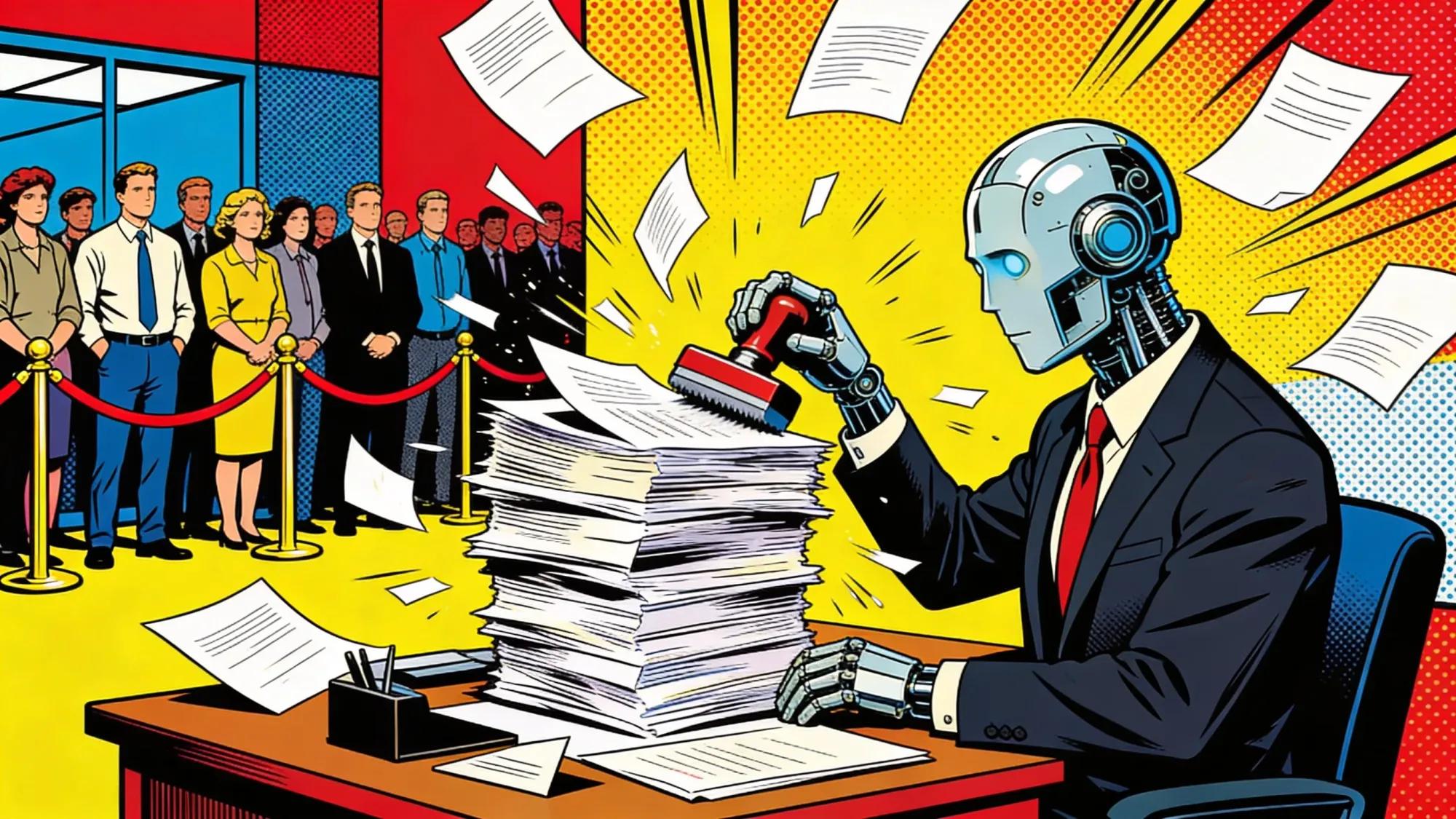


There is something fascinating about people who describe the future with absolute certainty. They speak as though it has already happened, as though they have simply been fortunate enough to see it a few years before everyone else. Tony Robbins, the American entrepreneur and motivational speaker, is one of those who have mastered the art. In an interview with Patrick Bet-David, he argues that humanity is approaching more change in the next ten years than throughout its entire previous history. Then he brings the perspective closer. Forget ten years, he essentially says. Look at the next 36 months. Artificial general intelligence, quantum computing, and humanoid robots are about to transform employment, the economy, and the very conditions of humanity's place in society. He sounds convincing, partly because he is describing developments that are already underway. But also because he uses one of the future industry's most effective techniques: turning uncertain predictions into a countdown.
I have always been skeptical of people who claim to know exactly what the future holds. History is full of technological prophecies that turned out to be premature, exaggerated, or completely wrong. At the same time, dismissing the developments we can actually see around us would be almost irresponsible. The difference between today's AI and the systems available just a few years ago is remarkable. Tasks that previously required specialized education, expensive software, and entire teams can already be performed by a single individual using digital tools. That does not mean the results are always good, or even correct. But it does mean that something fundamental is changing. Not merely the technology itself, but the relationship between human capability and the resources required to turn that capability into something real.
When Technological Possibilities Become Absolute Truths
Robbins builds his argument around three technological developments that could individually have enormous consequences. The first is artificial general intelligence, AGI, meaning AI capable of handling a broad range of intellectual tasks at a level comparable to, or exceeding, human ability. The second is quantum computing, whose computational methods could eventually transform everything from materials research to information security. The third is humanoid robotics, machines that, with the help of AI, are beginning to perform tasks in the physical world.
There are good reasons to take all three seriously. Stanford University's AI Index 2026 documents substantial progress in advanced AI models' ability to reason, program, and solve complex problems. BMW has conducted an industrial pilot project in which humanoid robots from Figure AI contributed to the production of more than 30,000 cars. Meanwhile, government agencies and security organizations are preparing today's digital infrastructure for the potential capabilities of future quantum computers. These are genuine, documented advances, not merely spectacular demonstration videos or investor presentations.
But when Robbins declares that AGI will arrive within 36 months and that superintelligence may follow within another few years, he crosses the boundary between technological analysis and personal conviction. There is still no universally accepted definition of AGI, much less a scientific consensus about precisely when it will emerge. An AI system outperforming a human in mathematics or programming does not automatically mean that it possesses general intelligence. Similarly, a robot successfully moving components around a factory is something entirely different from an autonomous machine capable of replacing human workers in any environment.
His description of quantum computing is even more dramatic. He recounts conversations suggesting that future quantum systems could break encryption and thereby affect banks, defense systems, and international security. The threat is real. In October 2026, the U.S. Government Accountability Office concluded that sufficiently powerful quantum computers could threaten today's encryption systems, potentially as early as the 2030s. However, the agency also confirmed that existing quantum computers do not yet possess those capabilities. That is a considerable difference from suggesting that the world's military and financial systems may be approaching an imminent collapse. International standards for quantum-resistant cryptography have already begun to be implemented.
The problem with predictions of this kind is not that they are necessarily wrong. The problem is that technological possibility, economic feasibility, and widespread social adoption are treated as though they were the same thing. Between a functioning prototype and a technology that transforms millions of people's everyday lives, there are often years of investment, infrastructure development, legislation, resistance, and practical difficulties. That remains true even when the underlying technology advances exponentially. Society rarely does.
The Labour Market Is Already Changing – But Not in the Way We Imagine
It is when Robbins begins discussing employment that his argument becomes particularly interesting. He tells the story of his 60-year-old brother-in-law, an experienced software engineer who lost his job after his company underwent changes involving AI. The man has a family, financial obligations, and decades of professional experience that suddenly seem to guarantee nothing. Robbins uses the story to illustrate the need for retraining, but I think it reveals something much bigger about our society.
For generations, we have encouraged people to educate themselves, specialize, gain experience, and build careers. Those who do everything right should reasonably expect some degree of financial security. But what happens when technology changes the value of professional expertise faster than human beings can adapt? What happens when twenty or thirty years of experience are no longer sufficient to protect someone's employment? And, above all, what happens to a society in which a person's economic and social value is still measured so heavily by their ability to remain employable?
There are already signs that the transformation is more complicated than the dramatic headlines suggest. In August 2026, researchers at the Stanford Digital Economy Lab published an updated study based on American payroll and employment data. They found no evidence of widespread unemployment across the economy attributable to AI. However, their findings indicated that employment among people aged 22 to 25 in occupations highly exposed to AI was approximately 19 percent below the level it would have reached had their employment followed the trend among similarly aged workers in less AI-exposed occupations. The researchers emphasize that this is an observed relationship, not definitive proof that AI caused the entire difference.
What made the findings particularly interesting was that the change appeared to occur primarily through reduced hiring rather than large-scale layoffs. Companies simply no longer needed to recruit as many younger employees for certain tasks. At the same time, a distinction emerged between formalized knowledge, the kind that can be documented in instructions and educational materials, and the tacit knowledge people acquire through years of practical experience. The latter has so far proved more difficult for AI to replace.
That is an important observation. We have long regarded digital skills and formal education as among the safest investments in the future. But perhaps the knowledge that is easiest to describe, standardize, and examine is also the easiest to automate. If that is the case, we may encounter a strange situation in which decades of practical experience suddenly become more valuable than certain newly acquired theoretical qualifications. Not always, and not in every profession, but often enough that we should begin reconsidering our assumptions about competence.
Why Must Human Beings Always Adapt to the Labour Market?
Robbins' solution largely revolves around education. Through his United Colleges of America initiative, he wants to help people acquire new skills in areas including AI, skilled trades, and nursing. He speaks about debt-free education, individually tailored teaching, and opportunities to establish a new livelihood quickly. The ambition is interesting, and the need for lifelong learning is difficult to dispute. But here, too, genuine opportunities are mixed with optimistic financial promises that deserve scrutiny. When Robbins discusses exceptionally high salaries for electricians, for example, he presents a picture that does not reflect the average American labour market. According to the Bureau of Labor Statistics, the median annual wage for electricians was $63,190 in 2025.
He also highlights the new American investment accounts for children born between 2025 and 2028, under which the government contributes $1,000 subject to certain conditions. He mentions the possibility that these accounts could grow to $300,000 before a child turns eighteen. But such an outcome would obviously not result from the government's initial contribution alone. It would require substantial additional deposits, favorable investment returns, or other assumptions. The initiative is real, but an attractive future scenario must not be confused with a guaranteed financial outcome.
Behind all these solutions lies the same fundamental assumption: human beings must continue to be economically productive according to the labour market's expectations. If someone loses one profession, they should retrain for another. If their knowledge becomes less valuable, they should acquire new knowledge. If their employment is threatened, they should learn to use the technology threatening it. In many situations, this is both necessary and sensible. But it is also a surprisingly limited perspective on a technology supposedly capable of transforming all of humanity.
We seem to have difficulty imagining a society in which technological progress is used not only to produce more, faster, and cheaper, but also to reduce people's dependence on traditional paid employment. During industrialization, machines released enormous productive capacity, but even then the question arose of who would own the machines and who would benefit from the resulting prosperity. The same question is returning now, with one crucial difference: AI is not merely automating physical labour or routine office work. It is beginning to perform activities we have long regarded as expressions of humanity's intellectual uniqueness.
I suspect we underestimate how deeply work has become embedded in our identity. When we meet someone new, we almost automatically ask what they do for a living. Not what they think about, what they are trying to understand, what they want to create, or what they hope to experience. Our profession has become a kind of social identity document. Someone who has left the workforce is often expected to accept that the most meaningful part of life is already behind them, even though they may still have decades of experience, curiosity, and creative energy ahead.
This is where I believe the discussion about the future often loses its way. It focuses on how we can save jobs, but far too rarely on why a person's opportunity to live a meaningful life should depend so heavily on someone else's willingness to purchase their working hours.
The Real Revolution May Be the Independent Human Being
There is another possible future, one that rarely receives the same attention as humanoid robots and superintelligent computer systems. It is a future in which people no longer need to belong to large organizations to create something of value. Where an idea no longer has to remain just an idea because its originator lacks a development team, an office, an investor, or sufficient capital. Where experience, curiosity, and the ability to recognize real problems can become just as important as technical specialization.
I can already see the beginnings of that possibility in my own work with PROTO. After many years working with complex productions, international projects, and practical problem-solving, I have begun using AI to develop digital concepts, applications, and prototypes independently. Not because I have suddenly become an expert in everything from programming to interface design, but because technology makes it possible to experiment in fields that previously would have been difficult to approach without considerable resources. It is still a learning process. Prototypes need testing, mistakes need correcting, and many ideas will never become commercial products. But the opportunity to try has fundamentally changed.
For me, this is far more interesting than the idea that everyone should retrain as an AI engineer. Perhaps someone in their sixties or seventies does not need to start an entirely new career. Perhaps they can instead use their accumulated experience to create something that was never previously possible. It might be a digital service, a local initiative, an educational project, a story, or a tool that helps other people. It does not even have to be profitable to be meaningful. Sometimes, simply rediscovering the ability to influence one's own circumstances is enough.
This is also a central idea behind PROTO PLUS, an initiative intended to give people over 60 the opportunity to explore AI and digital creation. Not because older people must become more employable, but because they should be able to remain independent, curious, and active on their own terms. Of course, this is not a universal solution. Many people lack sufficient financial resources, digital access, or personal security to experiment freely. But that is precisely why society should have a greater interest in making these opportunities accessible to more people.
We must also be willing to recognize technology's contradictions. AI can democratize creation, but it can also concentrate power. The largest models require enormous investments, data centers, energy, and access to information. If a handful of companies control the infrastructure and distribution channels, millions of people could become dependent on systems they neither own nor influence. The independent creator gains new tools, but may also become a paying tenant in someone else's digital economy. Lower barriers to developing a product also mean greater competition. Being able to create something is not the same as being able to earn a living from it.
Perhaps this is where the truly decisive question about the future lies. Not in how many robots can be installed in a car factory, or which year AGI might eventually emerge, but in how this new productive capacity will be distributed. Who owns it? Who controls it? Who gets to use it? And which people will be left outside?
Tony Robbins delivers a powerful message when he urges people not to wait for the future to arrive. But his perspective remains largely shaped by the society we already know: education, employment, efficiency, investment, and economic growth. That is understandable. He is a successful entrepreneur himself and has business interests in several of the fields he discusses. That does not invalidate his arguments, but it is a reminder that visions of the future also have authors and economic contexts.
I am not convinced that we will experience more change over the next 36 months than throughout the entire history of humanity. I am, however, convinced that we are already living through a period in which old assumptions about competence, work, age, and creativity need to be reconsidered. The future will not develop evenly or fairly by itself. It will contain failures, resistance, exaggerated promises, and genuine breakthroughs. Like every major historical transformation, it will create both winners and losers.
But we do not have to accept that humanity's role is simply to run faster in order to keep pace with the machines.
Perhaps the greatest opportunity offered by artificial intelligence is not that we become more efficient employees, more productive entrepreneurs, or cheaper resources in a new economic system. Perhaps it is that more people, for the first time, gain access to tools that make them less dependent on other people's permission, capital, and organizations.
The true measure of progress in the future should not simply be how much work machines can perform for us, but how much greater freedom human beings gain by using them.
And if that is the future we choose to work toward, perhaps we do not need to fear the next 36 months quite as much as Tony Robbins suggests. Above all, we need to start thinking seriously about what kind of future we actually want to create.
Sources and Further Reading
Tony Robbins – The Next 36 Months Will Change Everything, PBD Podcast #860
Stanford University – AI Index Report 2026
Stanford Digital Economy Lab – AI and the Employment Gap for Young Workers, August 2026
BMW Group – Humanoid Robots in Automotive Production, 2026
U.S. Government Accountability Office – Quantum Computing and Emerging Cyber Threats, October 2026
National Institute of Standards and Technology – Post-Quantum Cryptography
World Economic Forum – Future of Jobs Report 2025
U.S. Bureau of Labor Statistics – Electricians: Occupational Outlook