

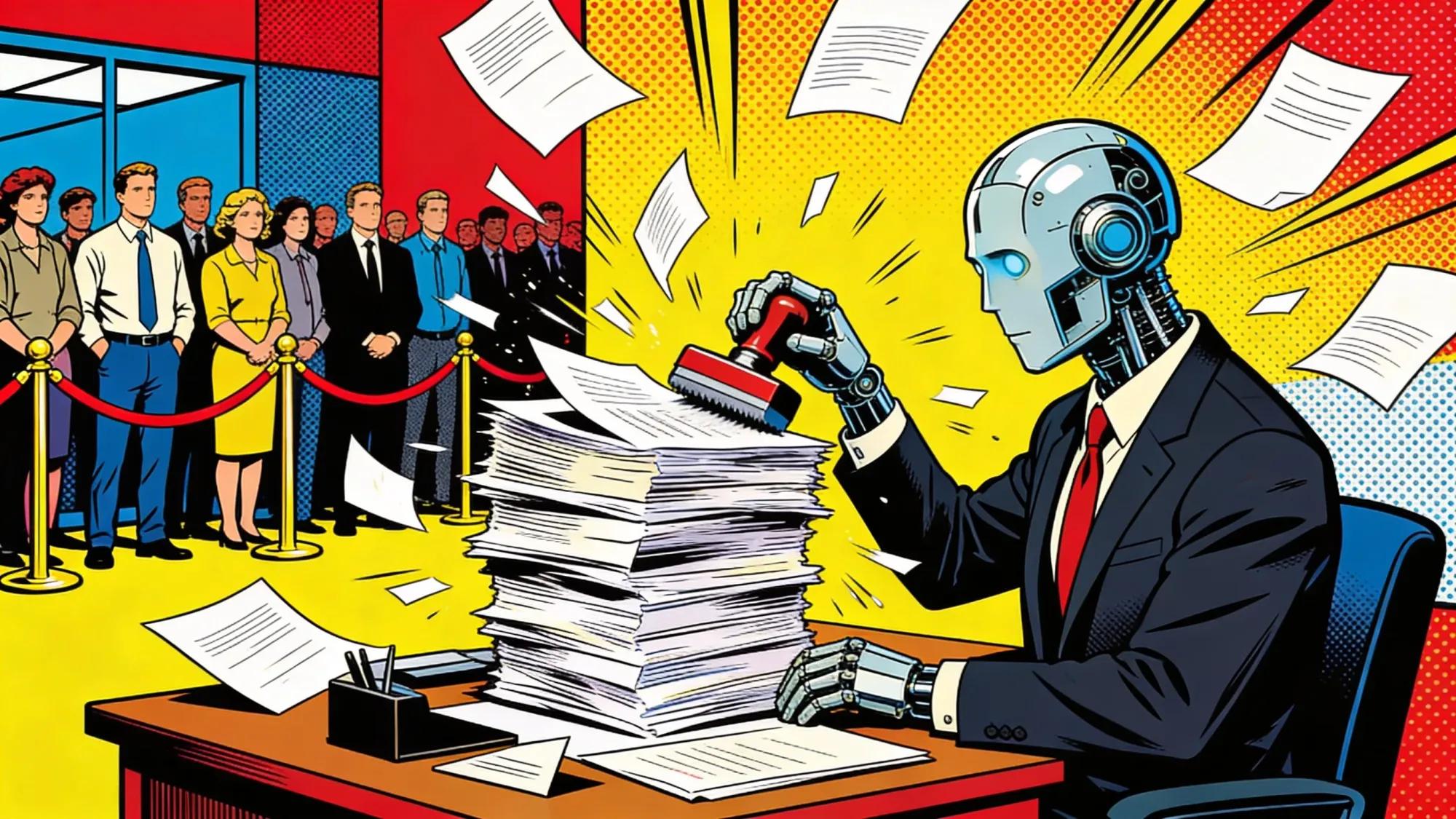
We talk about artificial intelligence as though it were just another IT system to be purchased, installed, and managed. At the same time, we worry that AI will take our jobs. But what if we have misunderstood both issues? AI is not merely another technology designed to make existing tasks more efficient. It is changing who can create, develop, and compete. And for many people, the greatest threat to their professional future may not come from AI itself, but from someone else who has learned how to use it.
We Have Put the Future in the Wrong Department
In an opinion article published in the Swedish newspaper Göteborgs-Posten, titled “More People Must Use AI at Work if Sweden Is Not to Be Left Behind,” representatives of PwC warn that Swedish companies and employees risk falling behind in the international development of artificial intelligence. Their message is that more people need to start using the technology, employers must invest in training, and business leaders must take greater responsibility for the transition.
It is difficult to disagree with that ambition. Sweden can hardly afford to stand on the sidelines of a technological transformation already affecting large parts of working life. But I believe the discussion starts in the wrong place. We still seem to regard artificial intelligence as a natural continuation of the information technology we have worked with for the past forty years. As if AI were primarily another software application, another digital platform, or another tool employees need to be trained to use.
I believe that is a fundamental mistake.
Technically speaking, AI is part of information technology. Without computers, programming, data centers, and digital infrastructure, today's AI systems would not exist. But that does not mean AI should be understood, organized, or developed in the same way as traditional IT. It would be rather like arguing that the automotive industry is primarily the responsibility of wheel manufacturers, simply because no car can operate without wheels.
For decades, IT has mainly been concerned with storing, processing, and distributing information, and automating processes already defined by human beings. We replaced typewriters with computers, archives with databases, paper forms with digital applications, and physical meetings with video conferences. These developments fundamentally changed society, but people still had to learn the systems and, to a considerable extent, adapt their work to the possibilities and limitations of technology.
AI is changing that relationship.
People can now describe what they want to achieve in ordinary language and receive assistance analyzing problems, developing ideas, writing code, constructing prototypes, and exploring possible solutions. Someone without formal programming education can begin building digital products. A person without graphic design training can experiment with visual concepts. An experienced professional can translate industry knowledge into working digital tools without first assembling an entire development team.
This does not mean specialist expertise has become unnecessary, or that AI always produces reliable results. But it does mean that the distance between having an idea and being able to test it has changed.
And that is something far more significant than another IT investment.
When the IT Department Becomes Responsible for Human Creativity
In many companies, responsibility for AI almost automatically ends up with the IT department. To some extent, that is understandable. Someone must be responsible for data security, personal information, technical integration, software licenses, and controlling which systems an organization uses. These are important matters, particularly when AI handles sensitive information or influences decisions with serious consequences.
But there is a considerable difference between managing the technical infrastructure and deciding what an organization's employees should be able to create, which working processes ought to change, and how human experience should be put to use.
It would be rather like giving the person responsible for a factory's electricity supply the authority to decide what the factory should manufacture. Electricity makes production possible, but electricity is not the business idea.
Yet that is precisely how we risk treating AI.
When new technology is introduced into a large organization, a familiar pattern quickly emerges. Working groups are established, strategies are developed, risks are assessed, suppliers are evaluated, internal guidelines are written, and pilot projects are launched. Then come training sessions, performance reviews, and further evaluations. Much of this is necessary. The problem begins when the process becomes more important than the transformation it was supposed to enable.
An employee who discovers that a time-consuming task could be radically improved with AI may find themselves trapped in an organizational no-man's-land. The idea may be too closely connected to everyday operations for the IT department to prioritize, too technical for the immediate manager, and too unconventional for the existing development budget. Eventually, it disappears somewhere between an innovation strategy and next year's financial planning.
Meanwhile, a small business, sometimes even a single individual, may already have built and tested a possible solution.
That does not mean large organizations should abandon their control systems. But it illustrates how organizational inertia can become a greater obstacle than a lack of technical competence.
There is another danger in how we measure success.
If AI is primarily treated as an IT issue, the obvious response is to purchase more AI tools, obtain more licenses, and train employees to use the systems. Management can then report how many people have access to the technology, how many have completed a training course, and how frequently the tools are being used.
But usage is not the same as value.
A company can have thousands of employees using AI every day without changing anything fundamental about the organization. If the technology is mainly used to write more emails, summarize more meetings, and produce more internal reports, perhaps all we have really accomplished is automating our own bureaucracy.
The interesting question is not how quickly we can perform old tasks.
It is which tasks still need to be performed at all.
AI May Not Take Your Job – But Someone Who Understands AI Might
We constantly hear warnings that artificial intelligence will replace human workers. And yes, AI will replace certain tasks. Some professional roles will change dramatically, others will probably disappear, and entirely new ones will emerge. It would be naive to claim otherwise.
But I believe we often misunderstand where the real competition will arise.
For many people, the greatest risk will not be losing their job directly to a machine. It will be losing their competitiveness to another human being who has learned how to use that machine.
Imagine two people with the same professional education, similar experience, and roughly the same responsibilities. One continues working as before, using the tools and methods that have served them well for years. The other begins using AI to analyze information, develop proposals, solve problems, and perform tasks that previously required considerably more time or assistance from other specialists.
After a year, the difference between them may be substantial. Not necessarily because one person is more intelligent, more experienced, or works harder, but because that person has learned to amplify their existing abilities through technology.
It is an uncomfortable thought, particularly in societies where education, professional qualifications, and long experience have traditionally provided a degree of security in the labor market.
We have become accustomed to the idea that learning a profession and becoming good at it creates lasting personal value. Of course, professions have always changed, but those changes have often been gradual enough for people to adapt over time.
AI may disrupt that pattern.
Tasks that once required years of technical specialization may, in certain circumstances, become accessible through new tools. Activities that previously justified dedicated positions may be automated or absorbed into other roles. A small team with the right skills may suddenly be capable of performing work that previously required a much larger organization.
That does not mean everyone who uses AI automatically becomes more productive, or that the quality of their work necessarily improves. Someone who uncritically accepts incorrect AI-generated answers can create serious problems. But a person who combines genuine professional expertise with the ability to use, question, and verify AI-generated results gains access to an entirely new level of working capacity.
I believe many people still underestimate this change.
We frequently discuss which professions are at risk of disappearing. Administrators, translators, programmers, customer service representatives, analysts, and other knowledge workers are often mentioned. Yet these same professions include people who, through AI, may be able to develop their roles, assume greater responsibility, and produce results that previously lay far beyond their individual capabilities.
A programmer skilled in AI-assisted development can focus more attention on architecture, security, and problem-solving. A journalist can use AI to examine large collections of documents and identify connections, while source criticism, interviews, and editorial responsibility remain human tasks. A project manager can explore alternative approaches and rapidly develop decision-making material that would previously have required extensive manual work.
The difference is not simply how much work gets done, but how human expertise is applied.
That is why I believe we need to express something that may sound provocative:
AI may not take your job. But someone who knows how to use AI might.
Of course, that statement is not universally true. Companies may reduce their workforces even when employees are highly competent in AI. Entire occupational categories may be affected by economic and structural changes beyond the control of individual workers. Employers may also fail to provide the training people need to adapt.
It would be unreasonable to place the entire responsibility on the individual.
But it would be equally irresponsible to allow people to believe they can simply ignore this development while expecting their professional position to remain unchanged.
The ability to keep learning has always mattered. With AI, it may become decisive.
This is particularly relevant to people who regard artificial intelligence as something too technical, too complicated, or simply irrelevant to their profession. Those who assume that the IT department or the younger generation will take care of it.
And that is one of the greatest dangers of continuing to describe AI as merely another branch of IT.
If people believe AI belongs exclusively to technical specialists, many will never discover how the technology could strengthen their own professional expertise.
That may ultimately be how people get left behind. Not because they lack experience or ability, but because they stop developing how those abilities are used.
Experience May Become More Valuable Than Technical Education
There is another dimension almost completely missing from the conventional debate about AI.
What happens to people who possess extensive professional experience but lack formal technical education?
We readily discuss how young people must be trained for the digital jobs of the future. We spend considerably less time discussing what people with thirty or forty years of practical experience might achieve if their knowledge could suddenly be translated into digital solutions.
I belong to the generation that began working long before personal computers, the internet, and smartphones became ordinary parts of everyday life. For many years, I worked with film production, concerts, international events, technical coordination, stage design, and complicated projects in which hundreds of different elements had to function together.
It was a world of practical problem-solving, people, technology, logistics, and limited resources. You learned to understand what needed to be achieved, identify the obstacles, and find ways forward.
Today, I increasingly work with digital concept development, artificial intelligence, and prototypes. I have no formal education in programming, but I do have experience defining objectives, understanding complex relationships, and recognizing when something does not work.
That turns out to be a useful foundation.
By combining that experience with AI, I can explore ideas and develop digital prototypes that previously would have required technical knowledge and financial resources I simply did not possess. Some work, others fail, and many need to be redesigned. But the opportunity to test them is now available.
This is precisely what I believe is missing from the conventional discussion about AI skills.
We still too often assume that people must first be educated in a particular technology before they can create anything with it. But AI makes it possible, in many situations, to reverse that process. You begin with a real problem, try to develop a solution, and learn the technology along the way.
Imagine what an experienced nurse might develop from years of firsthand knowledge about everyday problems in healthcare. Or a former logistics manager who has spent decades observing inefficient transport systems. Or a skilled tradesperson who knows exactly which administrative tasks consume time that should be spent doing the actual work.
They do not necessarily need to become programmers to begin exploring their ideas. They need access to tools, opportunities to experiment, and sufficient understanding to recognize the technology's limitations.
There is a democratic dimension here that deserves far more attention.
For much of the digital era, the ability to create new technological products has depended on money, formal education, or access to specialists. A good idea has rarely been enough. You also needed the resources to turn it into something tangible.
AI is beginning to change that.
It does not mean anyone can build a secure, commercially successful business over a weekend. But the distance between an idea and a practical experiment has become dramatically shorter.
Perhaps we should therefore stop talking about older people primarily as a group at risk of falling behind in digital development. Many possess knowledge, experience, and ideas that previously had no realistic path toward implementation.
Their greatest challenge may not be learning technology.
It may be discovering that technology has finally become accessible to them.
Sweden Needs More Creators, Not Just More AI Users
This is the perspective from which I read PwC's warning that Sweden risks being left behind unless more people use AI at work.
The concern is understandable. But it needs to be accompanied by another question: What exactly do we want people to use this technology for?
If the ambition is simply to make Swedish employees as frequent users of AI as workers in other countries, we risk measuring the wrong things. The number of users tells us relatively little about the economic value technology creates, the problems it solves, or the new opportunities it makes possible.
Sweden is already among the leading countries in the European Union when it comes to reported business adoption of AI. According to Statistics Sweden, approximately 35 percent of Swedish companies with at least ten employees used AI in 2025, compared with roughly 20 percent across the EU. That does not mean everything is working well, but it demonstrates why international comparisons need careful interpretation before we draw sweeping conclusions about Sweden falling behind.
I would therefore like to see a different kind of national discussion.
Not only about how AI should be introduced into existing organizations, but about how people can gain greater opportunities to create new businesses, develop their own solutions, and challenge established working methods. Not only about professional development for employees, but also about how entrepreneurs, older professionals, small-business owners, and people without technical education can use their experience in entirely new ways.
We certainly need education, but perhaps not exclusively the kind traditionally associated with IT. We need to strengthen people's ability to define problems, understand context, evaluate information, assess risks, and translate ideas into practical results.
These abilities do not belong to one particular profession.
They are human abilities.
At the same time, we must remain realistic. AI can make mistakes, reproduce biases, create security vulnerabilities, and be exploited for fraud and manipulation. Human responsibility and professional judgment cannot simply be replaced by a machine that appears confident in its answers.
But these risks do not mean that development must be handed over entirely to IT specialists and centralized control functions.
On the contrary, more people need to understand both the possibilities and the limitations.
The essential distinction is between technical responsibility and creative responsibility. IT departments must ensure that systems are used securely and reliably. But decisions about what should be developed, why it should be developed, and what value it creates must belong to people throughout the organization.
Otherwise, we risk building yet another technological layer on top of the organizations we already have, rather than asking what kinds of organizations we actually need.
The Biggest Transformation May Not Be About Technology at All
When we look back at industrialization, we tend to talk about steam engines, electricity, and factories. Yet the truly significant changes also concerned how people lived, worked, organized themselves, and created economic value.
Electricity did not become revolutionary merely because it could replace steam power. Its full significance emerged when companies began redesigning production around entirely new possibilities.
I believe we risk making a similar mistake with AI.
We focus on tools, models, licenses, and user numbers. We discuss how many hours can be saved and how many tasks can be automated. But we spend far less time considering what happens when people can create things that previously lay completely beyond their financial or technical reach.
That may be where the greatest transformation lies.
Someone with an idea no longer necessarily has to begin by looking for investors, hiring specialists, or establishing an organization. In some cases, that person can start by developing a working prototype and finding out whether the idea has merit.
That is not the same as building a complete business, but it can make the difference between an idea that never leaves a notebook and one that actually gets tested.
We frequently talk about AI transforming the labor market by automating certain jobs. That is undoubtedly part of the development. But we should also discuss how many new possibilities may emerge when people are no longer as dependent on substantial financial and technical resources to turn their knowledge into action.
Perhaps the most important question is therefore not how AI can make people work more efficiently within the organizations that already exist.
Perhaps it is how AI can help people become less dependent on those organizations in order to create something meaningful.
That perspective changes the entire discussion.
Because if AI is primarily treated as IT, we will continue thinking in terms of systems, implementation, user training, and organizational control. But if we begin to regard AI as a technology that makes human knowledge and experience more actionable, an entirely different conversation opens up about creativity, independence, education, work, and economic development.
Sweden does not need to choose between technical security and creative freedom. We need both. But we must understand that they represent different responsibilities and should not be confused.
It would be a strange historical irony if, just as technology begins making it possible for more people to turn their ideas into reality, we build administrative structures that restrict those very opportunities.
AI is technically part of IT. But its significance for people, working life, and society is far too great to be reduced to an IT issue. And perhaps that is where Sweden needs to begin if it genuinely wants to avoid being left behind. Not simply by teaching more people to use another digital tool, but by giving them the opportunity to discover what they are actually capable of creating.
The future will not belong exclusively to those who are best at using technology. It will also be shaped by those who dare to think beyond the structures that technology was originally designed to serve.
And to anyone who still regards artificial intelligence as something for the IT department, I would say this:
You do not need to become a programmer. You do not need to become a technical expert. But you do need to understand how AI can transform what you already know.
Because the real risk is not only that a machine learns how to perform your work.
It is that you stop developing the way you work, while someone else continues.
Sources and Further Reading
Göteborgs-Posten – More People Must Use AI at Work if Sweden Is Not to Be Left Behind
PwC Sweden – Hopes and Fears 2026
Statistics Sweden – Swedish Companies Among Europe's Leaders in AI Adoption
International Labour Organization – The Impact of Generative AI on Jobs, Productivity and Work Organization